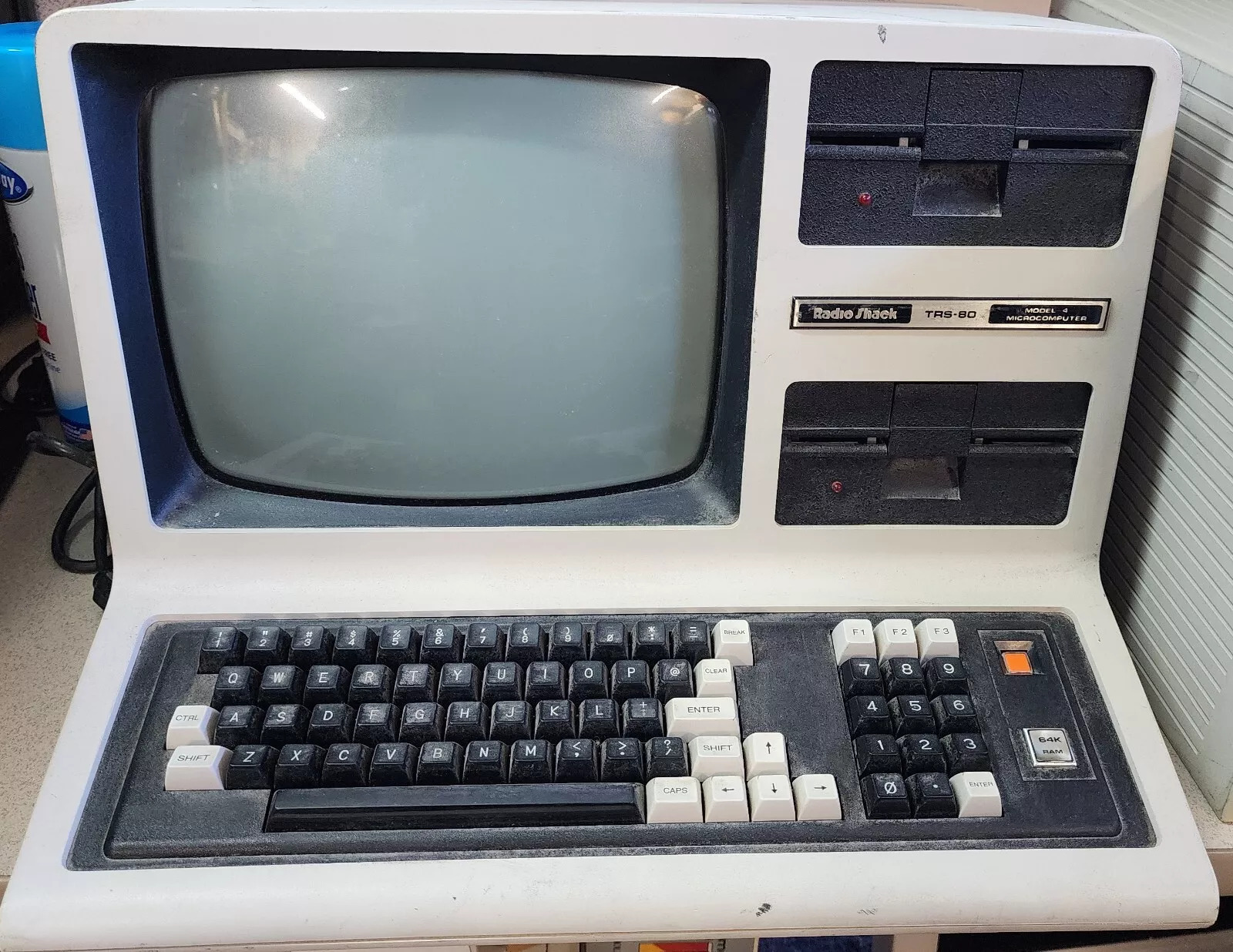
I'm a software developer and computer guy. I've been using computers since 1980 and got my start on the TRS-80 Model 4 running a Z-80 processor at a whopping 2.0 MHz with 16 KB of RAM! I also used early Apple computers in middle school (like the Apple II) learning word processing and touch typing in the early 1980s. Growing up in the 1980s, I got to see personal computers evolve and take off in society. I witnessed the birth of Atari computers, the Commodore 64, the Amiga, the Macintosh Plus, the Commodore VIC-20, and many other early computers. I was also around to see the birth of the original IBM PC and the growth of the "PC-compatible" clone market.
By the early 1990s, modems had advanced enough to start becoming useful. The first modem I used had a blazing speed of 9600 bits per second (bps). A few years later, I upgraded to a 14.4 kbps modem and the world of online Internet access was opened up to me for the first time. Back in 1992, most people were using dial-up modems to connect to local BBS'es (bulletin board systems). These bulletin board systems were a precursor to the modern form of the World Wide Web (WWW). There was also the Gopher protocol which became popular when the WWW was still in its infancy. A Gopher system consisted of a series of hierarchical hyperlinkable menus. Then, in January of 1993, my world forever changed – NCSA Mosaic was released by Marc Andreessen and Eric Bina from the University of Illinois at Champaign-Urbana.
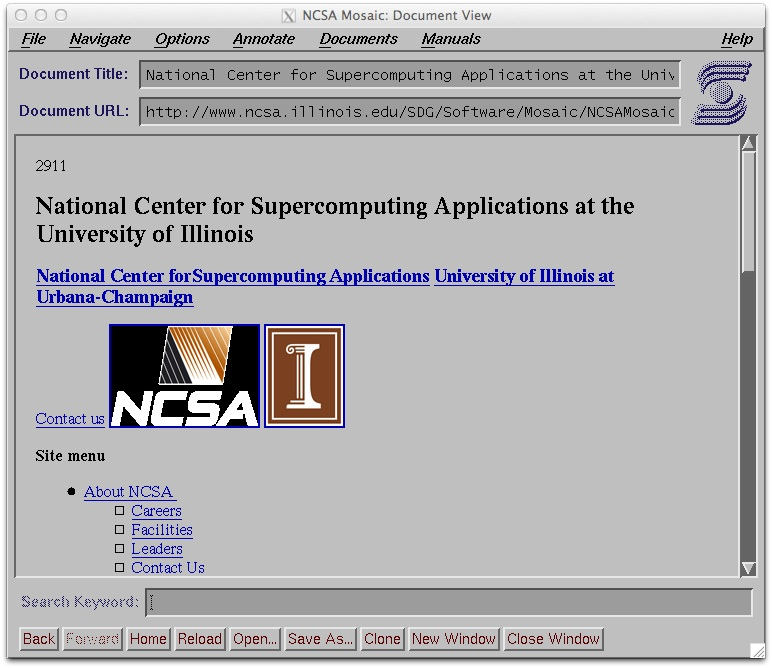
Although Mosaic was not the true first graphical web browser, it was the one that became the most popular and was widely-used by everyone I knew. It supported the Hypertext Transfer Protocol (https), File Transfer Protocol (FTP), Network News Transfer Protocol (Usenet), and Gopher too. It was the first web browser to display images inline with text (instead of opening a separate window). Mosaic had an intuitive interface, was stable, and easy-to-install on personal computers running Windows 3.1. Back then, the term "web surfing" was appropriate because when you were browsing the WWW you were randomly jumping around from site to site. There were no decent search engines or centralized directories. Most of the sites you discovered were linked to from other sites you were browsing. People started keeping lists of their favorite URLs so they could share with others and go back to later. (NCAS Mosaic had a feature called "Hotlist" which was an early predecessor of "bookmarks" found in modern browsers). In 1994, Jerry Yang and David Filo created a website named "Jerry and David's guide to the World Wide Web". The site was a human-edited web directory, organized in a hierarchy, as opposed to a searchable index of pages. In March 1994, "Jerry and David's Guide to the World Wide Web" was renamed "Yahoo!" and became known as the Yahoo Directory.
Sometime between 1993 and 1994, I became fascinated with websites. I wanted to know how I could create my own website and put it on the Internet. Back then, there were no "free hosting" services. No blogs. No social media. Nothing. To host your own website you had to purchase a domain name from Network Solutions, pay a company for hosting (or run your own server), and design your own webpages from scratch. The first thing I did was taught myself HTML. I used to spend hours visiting different websites and viewing the source code of the page. I would make a tiny change to the code, and then view the page to see what changed. I would then dig in and read the HTML language specs from the WC3. Doing this slow, reverse-engineering method over many months, I taught myself how to create websites. I also learned PERL and CGI programming. I put together my first website around this time and, along with some friends, started a web development company to offer services to business customers in this new and quickly-growing market. From the mid-to-late 1990s, we created custom websites for people looking to get their businesses online.
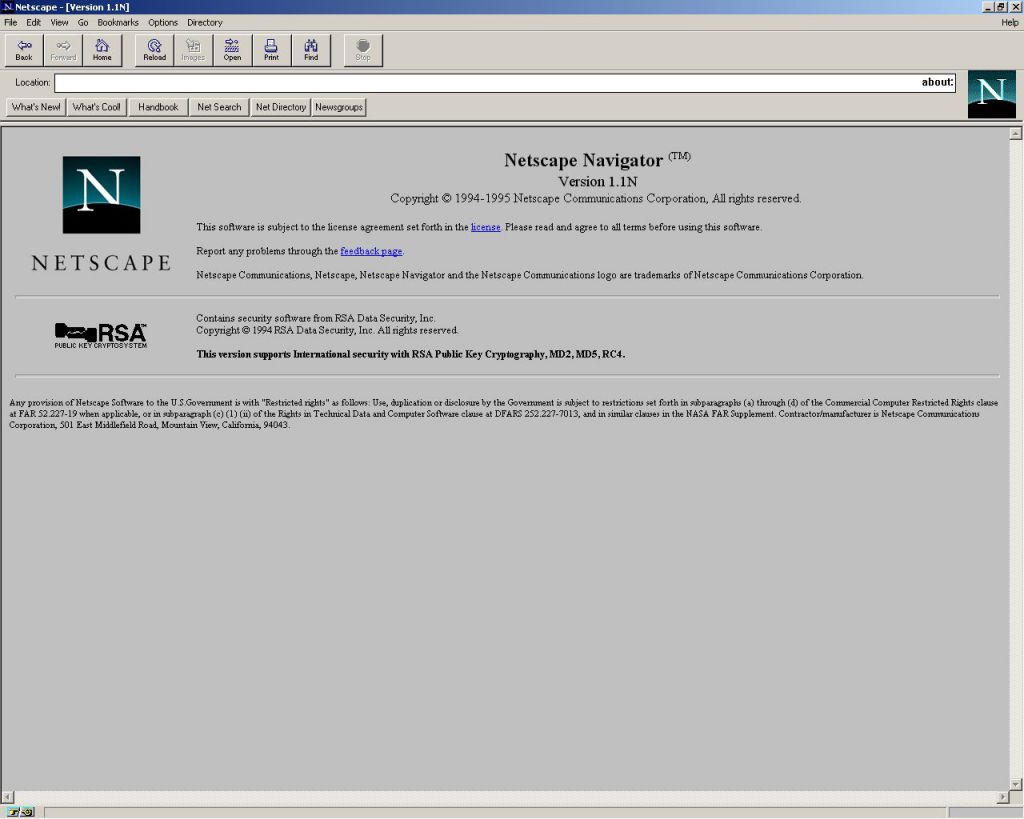
In 1994, the lead developers of Mosaic founded the Netscape corporation and released their first product: Netscape Navigator. This quickly became the most popular web browser on the Internet. In 1995, Netscape decided to add a programming language to their browser (Javascript) to allow developers to add dynamic behavior to their web pages. Prior to this point, all web pages were static — containing only text and images. In 1995, Macromedia issued the first release of their Shockwave Player plugin for Netscape Navigator (which eventually became "Adobe Flash"). Shockwave allowed developers to create interactive multimedia applications which could be viewed by people who had the plugin installed in their web browser. These two technologies (Javascript and Shockwave) opened up a whole new world for web developers. Now, instead of just creating static pages with text and images, developers could create rich interactive experiences for web surfers.
I purchased a copy of Danny Goodman's "The Javascript Bible" in 1997 and read it from cover to cover. I taught myself Javascript and Shockwave (Flash) and started using them to create interactive websites for people and businesses in the mid-to-late 1990s. Towards the end of the 90s, I was getting tired of the hustle and daily-grind of running my own freelance business and decided to work for an Internet company instead. The company I chose – Open Book Systems (OBS) – was a pioneer in the industry. They built the first online bookstore on the Internet in 1992 (two years before Amazon was founded). OBS had a long history of firsts on the Internet and worked with famous people like Stephen King, Robert Coover, Lester Grinspoon, John Ashbery and John Wiley. They also produced websites for Miramax Films. I had the opportunity to work on the Flash animation for the Studio Ghibli film "Princess Mononoke" (released in the US in 1999) as well as other promotional websites for Miramax during the late 1990s / early 2000s. During this time I also worked on sites for schools, universities and international medical and scientific publishing companies.
While working at OBS, in 1998, I got my first introduction to Linux. This was during the era of Windows 98 and we had a print server running Windows in the office that was highly unstable. The print server was constantly crashing, freezing and having problems. Before you could print a document, you first had to fight with the print server. A colleague suggested installing Linux on the machine instead. At this point in time, Linux was relatively new and had only been around for 6-7 years. I'd heard of it but, I had never used it before. My coworker had previous experience with Linux and installed it on the unstable print server. I watched with great interest. I wanted to learn as much as I could. Our print server experiment was a great success! The machine became solid as a rock and ran flawlessly for many years printing documents without any problems.
This was an eye-opener for many of the tech guys in the office. Maybe we could run computers without relying on Microsoft for the operating system? After the print server experiment, we started testing Linux-based web servers too. During this time period, Linux on the desktop just wasn't mature enough yet. The most "fully baked" Linux distribution for Windows users at the time was probably Red Hat Linux but, they were mainly focused on enterprise customers. I installed Red Hat Linux on one of my home computers so I could continue learning about the new operating system (OS). Learning Linux back in the late 1990s / early 2000s came with a steep learning curve. Things back then weren't as developed as they are now. You had to do everything manually from scratch (e.g. compiling device driver code for your specific hardware). This led me on a quest to find an easy-to-use Linux distribution that I could run on my desktop computer at home and also to learn how to use Linux proficiently. I started experimenting with different Linux distributions — installing them on my computers and trying them out.
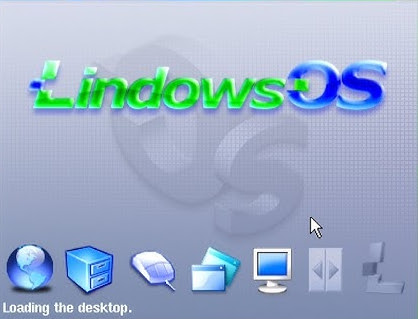
This is what led me to my next gig: working for a Linux company. In 2001, I read an article on ZD Net about a new product called Lindows OS. Their original goal was to run Microsoft Windows programs on Linux. I downloaded a copy of their OS, installed it on my computer and started using it. I also joined their community forum to get help with technical problems and interact with other people running Lindows. I participated in the community for two years and rose to the position of moderator. I helped other people with tech support questions and engaged the community with polls, stories, links and information about Linux. The company liked what I was doing and, in 2003, offered me a job managing the online community. I packed my stuff and moved to California where I worked full time as the Community Liaison for Lindows. Later, the company got sued by Microsoft. They claimed that the name was too similar to "Windows". Microsoft lost their case in court and ended up paying to settle the lawsuit. One of the requirements was that Lindows had to change their name. So, in 2004, they renamed the company to Linspire instead.
The company gave up on it's original goal of trying to run Windows software on Linux. (It turned out to be too problematic to be practical). Instead, they focused on trying to make an easy-to-use desktop Linux distribution. And, they did a lot to advance desktop Linux during their time (regardless of the controversies). Remember: they existed three years before Ubuntu released their first product. Some of the innovations that Linspire introduced: a graphical installer which detected most hardware, the "Click-N-Run" (CNR) software library, the Desktop Linux Summit (an annual trade show), and computers in major retail stores with Linux preinstalled. These things are commonplace in the modern world now that Linux on the desktop has fully matured. But, back in the early 2000s these concepts were innovative and led to the systems, projects, and companies that we have now. I worked at Linspire until 2007 then I left to join a different Michael Robertson company: MP3tunes.
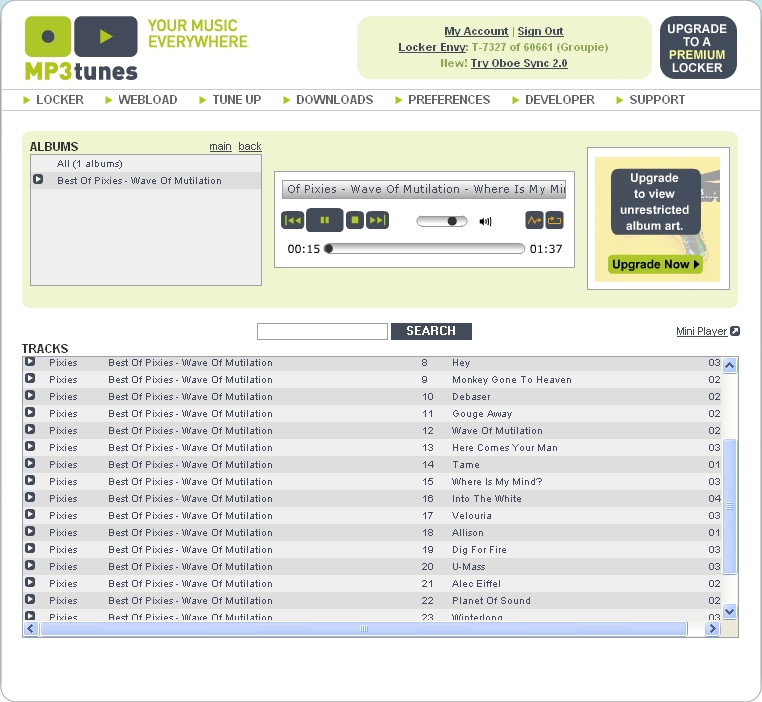
MP3tunes was a music store and "locker" company which was a continuation of Robertson's previous work at MP3.com. In 2000, MP3.com launched their "My.MP3.com" service which enabled users to register their CDs and then stream digital copies online from the MP3 servers. The distinction here is that the user didn't upload their own copy. They simply put the CD into the computer to "prove" that they owned the disc. The software verified the data and then automatically "unlocked" a copy on the server (without having to upload file over a slow dial-up modem). The record industry did not like this and sued MP3.com claiming that the service constituted unauthorized duplication and promoted copyright infringement. The court ruled in favor of the record labels against MP3.com on the copyright law provision of "making mechanical copies for commercial use without permission from the copyright owner." They settled the lawsuit, and then sold the company to Vivendi Universal in 2001 for $372 million in cash and stock.
In 2005, MP3tunes.com launched as a digital music store which sold downloadable music which was sold without digital rights management (DRM). They also provided a corresponding service named "Oboe" as a digital music back-up service (later referred to by the company as a 'music locker'). MP3tunes stopped selling digital music in 2008 and focused on the locker as their primary product. To avoid the legal copyright trouble that MP3.com had, the new company only stored the user's own music which they had to upload. This made sure that each track was a copy from the user's actual CD and not a generic copy of the file shared by everyone.
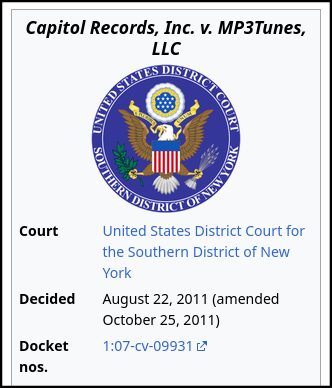
MP3tunes was providing cloud music storage years before other companies like Google, Amazon, or Apple were doing it. The entire 'music locker' concept was a gray area with a lot of unanswered legal questions. None of the big companies wanted to jump into the game and get sued by the record companies. Unfortunately for MP3tunes, they did get sued by the music industry. The lawsuit: Capitol Records, Inc. v. MP3Tunes LLC case had a mixed outcome, with the court holding that MP3tunes was generally not liable for copyright infringement by its users, but was liable in cases where takedown notices were ignored or where the CEO himself had seeded the site with unlicensed music. The decision was viewed as a victory for online storage and cloud music services, but the legal battle was very costly for the company. MP3tunes filed for Chapter 7 bankruptcy in April of 2012. The victory in court paved the way for all the other music services that came along later. Services like Amazon Music wouldn't exist today if MP3tunes had never existed back in 2005.